Middle School
GRADES 6-8: “I STAND IN THE WORLD”
Awakening independent thinking + purpose
In the middle school years, students stand on the threshold between childhood and young adulthood. Waldorf education meets this stage with a curriculum that challenges the intellect, engages the imagination, and strengthens the will. Lessons are dynamic, experiential, and designed to help students think critically, feel deeply, and act with purpose.
A Curriculum That Inspires Inquiry
Middle school students explore an integrated curriculum of math, science, humanities, world languages, the arts, and athletics. Subjects are presented in three- to four-week Main Lesson blocks, allowing students to immerse themselves deeply in a topic before moving to the next.
Teachers encourage students to question, reason, and make connections between disciplines—fostering curiosity, confidence, and a growing sense of independence.
Why Waldorf For The Middle School Years?
Curriculum that meets the adolescent: Lessons engage both the growing intellect and the emotional life, helping students connect learning to meaning.
Integrated academics and arts: Science, math, humanities, and world languages are woven together with music, drama, and visual arts to inspire creativity and critical thinking.
Learning through experience: Hands-on experiments, fieldwork, and real-world projects turn abstract ideas into lasting understanding.
Teachers who know + guide each student: Long-term teacher relationships offer steady mentorship and deep understanding during a time of change.
Focus on community + connection: Collaborative work, class trips, and shared service experiences build confidence, empathy, and teamwork.
Cultivating independence + purpose: Students are encouraged to think for themselves, take responsibility, and develop their own sense of direction.
Whole-child education: Intellectual growth is balanced with physical activity, artistic expression, and social-emotional learning.
Preparation for life beyond the classroom: Graduates emerge as curious, capable, and compassionate young people ready for high school and the wider world.
Guiding Principles: A developmentally aligned curriculum
-
In the middle school years, students stand on the threshold between childhood and young adulthood.
Waldorf education meets this stage with a curriculum that challenges the intellect, engages the imagination, and strengthens the will. Lessons are dynamic, experiential, and designed to help students think critically, feel deeply, and act with purpose.
-
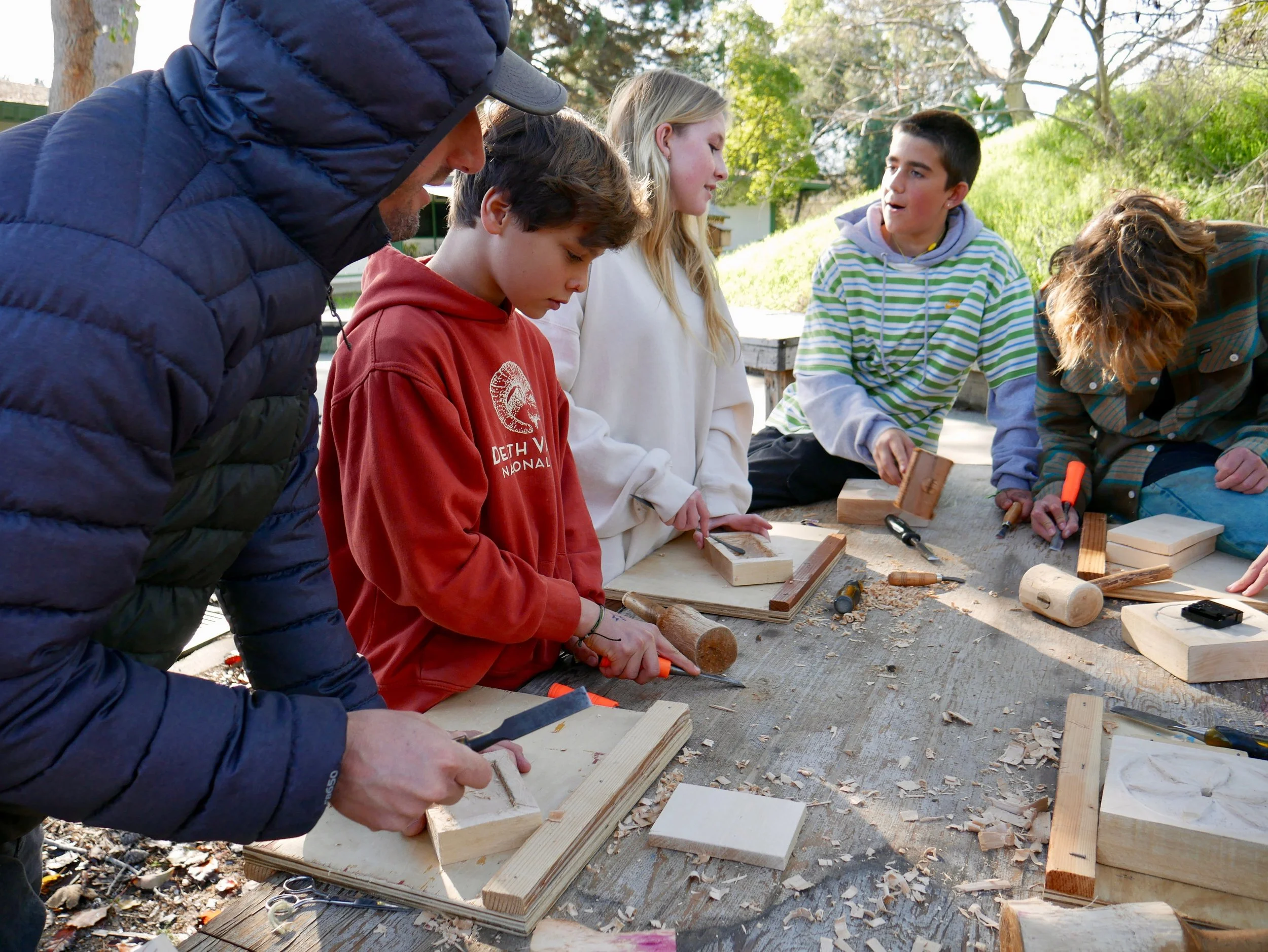
Middle school students explore an integrated curriculum of math, science, humanities, world languages, the arts, chemistry, physics, geography, history, and athletics These students also dive deeper into woodworking.
Subjects are presented in three-to four-week Main Lesson blocks, allowing students to immerse themselves deeply in a topic before moving to the next.
Teachers encourage students to question, reason, and make connections between disciplines—fostering curiosity, confidence, and a growing sense of independence.
-
Hands-on learning remains central:
Science lessons include observation, experimentation, discussion, and lab work that nurture disciplined thinking.
Mathematics becomes more abstract through algebra, geometry, and practical applications.
Humanities come alive through history, literature, and cultural studies that encourage empathy and global awareness.
Artistic expression—through drawing, painting, music, drama, and movement—continues to enrich every subject.
-
Adolescence is a time of tremendous growth, both inward and outward. Waldorf teachers guide students through these changes with warmth, humor, understanding, and respect.
Students are supported as they:Strengthen self-discipline and responsibility
Deepen relationships with peers and teachers
Discover their own voices through artistic and academic expression
-
SOCIAL + EMOTIONAL LEARNING
Middle schoolers engage in meaningful projects, class plays, and outdoor experiences that build cooperation, resilience, and confidence. Service learning and community-building activities help students recognize their role in something larger than themselves.
-
By the end of 8th grade, students emerge as capable, curious, and compassionate young people ready to take on high school with confidence.
They have not only learned how to think, but how to care—and how to bring imagination, intellect, and integrity to whatever path they choose next. -
Each day, our students start with a two-hour Morning Lesson. These first two hours of the school day focus on one of the core academic topics assigned to each grade (i.e. Ancient Egypt and the Nile, Physics, Business Mathematics), with a block of three to four weeks given to each topic.
-
Waldorf education emphasizes ‘technical prudence,’ which is a thoughtful, developmentally appropriate approach to technology that prioritizes human connection, hands-on experience, and imaginative engagement.
In 7th and 8th grades, the Cyber Civics curriculum teaches students to use technology responsibly. Just as traditional civics prepares young people to be good citizens in the real world, Cyber Civics teaches students how to navigate the internet and become “ethical, safe, and productive digital citizens.” This curriculum is activity-based, incorporating role-plays, projects, and case studies. -
Why Waldorf Education Doesn’t Use Traditional Textbooks:
In Waldorf schools, learning is meant to be alive, creative, and deeply personal—not just memorized facts from a printed page. Rather than relying on standard textbooks, students create their own Main Lesson Books: richly illustrated, hand-written records of what they’ve learned.
This approach supports the child’s development in several key ways:
Deeper Understanding Through Creation
By writing, drawing, and illustrating their own lesson books, students process information more actively and retain it more deeply. Learning becomes an artistic and intellectual experience, not passive absorption.
Bringing Subjects to Life
Rather than presenting dry facts, Waldorf teachers tell vivid stories, give lively demonstrations, and guide hands-on experiences. These are then expressed in each child’s own words and images—making learning feel meaningful and alive.
Integration of Art and Academics
Main Lesson Books weave together academic content with visual art, poetry, form drawing, and color. This strengthens both comprehension and creativity, engaging the whole brain and the whole child.
Pride and Ownership
Students take great pride in their books, which become treasured keepsakes for both families and students. They are not just learning tools—they're evidence of growth, individuality, and effort.
In short, Waldorf education avoids textbooks not out of rejection, but out of a deeper commitment: to teach in ways that are human-centered, developmentally appropriate, and emotionally resonant.
Each child creates their own Main Lesson Book—a personalized, beautifully illustrated record of their learning.
These books include:
Final-draft writing
Math or science process notes
Freehand illustrations
These treasured books are not just assessments—they become keepsakes, cherished by families for years.
-
Middle Schoolers dive deeper into subject classes, learning more advanced concepts and deepening their connection to each:
Spanish
Handwork - hand sewing, four needle knitting, and machine sewing
Woodwork - crafting useful and imaginative items through the proper use of hand and machine tools
Flute and Recorder
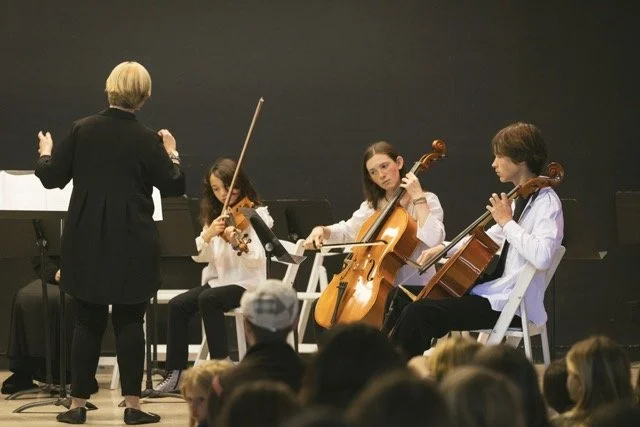
Strings Orchestra
Gardening
Physical Education and Sports
Outdoor Education and Experiential Trips
Middle School Grades Curriculum